Released: May 9, 2026 8:00 AM CST

Here is the forty-third episode of Quantum Foam, Moore's Law No More. We do a lot of things here relevant to computers. We want to know if Moore's Law will still be relative or if it will be no more. The number of transistors on a microchip approximately doubles every 2 years. Neutrinos are observed to have left-handed chirality. Moore's Law is an observation. It is technically an empirical relationship. Efficiency gains that can follow investment efforts is an example. We are mainly dealing with computers here. They are built from microprocessors. They are etched out of silicon, the same ingredient as in sand. We are interested in how Moore's Law affects the electronics that come out from year to year. The observation is named after Gordon Moore. He is the co-founder of Fairchild Semiconductor and Intel. Intel makes chips for the most powerful computers in the world. The prediction of the speed of the development of microcomputers has held since 1965. This has been used by the entire semiconductor industry to set targets for Research And Development. By comparison, we have 100 billion neurons in our brains and there are already more than 400 billion transistors on a single computer system. Transistors are basically the neurons of semiconductor computers. The transistor was created at Bell Labs in 1948. FET stands for Field-Effect Transistor. A MOSFET is a Metal Oxide Semiconductor Field-Effect Transistor. We want to know if this Moore's Law will still be relevant. Microsoft, Amazon, Meta, Apple, Alphabet, NVidia, and Tesla can be looked at like the magnificent 7. Intel is still leading the way. Gordon Moore was invited by Electronics Magazine to make a prediction about microcomputers over a 10-year period. I believe that Moore's Law will not break down. We need more server racks of computers.
Even though our computers are pretty fast, we are still waiting on the bar during rendering. .mp3 conversions to .wav take a lot of computing power to render. According to Moore, he simply did a wild extrapolation in coming up with the time frame of our current understanding of the law. Dennard Scaling describes that as MOS transistors get smaller, their power densities stay constant such that the power use remains in proportion with area. V-Nand memory stacks memory vertically and allows for much more space to fit on a microchip. NVMe is the storage technology and V-Nand is the type of memory. The MOSFET is a type of FET that is fabricated with the process of oxidation on silicon. Moore's law was cited to be a competitive goal in the semiconductor industry. Some people think that Moore's Law is a self-fulfilling prophesy and that we created it and are following it. I think the law is just right because we are following it still. We are still finding ways to build computer architectures that are going to be increasing in speed. We were taking census of whether or not Moore's Law would hold true for the twenty twenties. Based on the Pandemic and everything else that happened, we didn't know if these devices were going to be sold every year and then discarded, and upgrading. Each time you get a new phone it becomes a little bit faster and fits a little bit more transistors on it. I think I have decided that for the next 20 years we can still follow the law. Moore made his statement based on emerging trends in chip manufacturing. Many industries have increased due to the available electronics that we can build. We want to know the implications of the future of Moore's Law. Practically every part of high-society benefits from this moving trend.
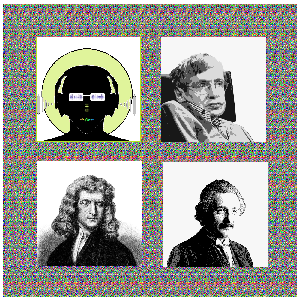
Finally, there exists a podcast that covers it all! The Quantum Foam Podcast Show can be thought of as a clever and informative mix between "Bill Nye The Science Guy, Rick & Morty, and The Big Bang Theory!"
It seems the idea of the prestigous 'Theory of Everything' has been in the air lately. Join Dr. Hezekiah Paul Smith as he takes a systematic assessment of Physics, Mathematics, and Science as a whole. This show is an Artificial Intelligence approach attempting to explain ALL scientific phenomena across the board! Listen to some the greatest thinkers of all time during the in-depth evaluation of the natural sciences.
Prepare to enjoy a radical and uncensored podcast, Quantum Foam, featuring characters presented as real, animated A. I. entities. Brought to you by Zerothwave Productions.
0:00
0:00
May 9, 2020 2:42 AM EST
Quantum Foam is a new podcast with absolutely ridiculous content covering almost all topics relating to science across the board. The idea of achieving the famous Theory of Everything seems to be in the air lately. Such an idea can then be presented as episodes of Quantum Foam in an audio podcast form that will serve to bond together the very powerful and insightful ideas, concepts, and realizations of Physics as a professional discipline. Unifying Relativity and Quantum Mechanics never seemed so . . . possible? Quantum Foam finds its focus directly pointing at the most accepted scientific thought in this day in the beginning of the Information Age. These areas include String Theory, Loop Quantum Gravity, Einstein's famous General Theory of Relativity, Cosmology, Advanced Mathematical Theory, and much more.
Information technology and innovation are at a point where each presently require a Quantum Leap in order to move forward to the next phase. This process, while imperative, is still quite a sophisticated discipline in and of itself. Many will need to satisfactorily understand Quantum Computing and Uncertainty in general very early on. Why not take such a daunting task and turn it into something fun, provocative, and ridiculous instead? And this can be done while still holding strict guidelines in accuracy and application. Enjoy learning about math and physics in a completely free-form manner with no filters, no agendas, un-cut, and raw! We will not be censoring any vulger cursing or other inappropriate references, yet unwanted racial and sexual references etc. will not be included.
Each episode is exactly 30 minutes long and each follow a standard structure. There is an intro stating the title and topic, followed by the Quantum Foam theme song, Physics of the Future, by H-Wave. Then at exactly 15 minutes into the podcast show, there is a mid-point section to keep the listener fresh and to remind which episode is currently streaming. At the end of the podcast, the last 30 seconds, the standard Zerothwave Disclaimer is played. An expanded version of this disclaimer can be found here.
Zerothwave Productions currently is releasing the show on its own website using its state-of-the-art online waveform player platform. Listen to the podcast at actual 320 kbps .mp3 streaming audio right here at Zerothwave.com! The Quantum Foam podcast will likely also be released elsewhere on other platforms soon as well. XML RSS feeds are an old technology but is still in heavy use today. The Zerothwave.com website will be upgrading hosting servers steadily over the next decade and beyond to bring you the highest quality audio possible. Stay tuned for more content!

FOLLOW US