Released: May 9, 2026 8:00 AM CST

Here is the twenty-eighth episode of Quantum Foam, The Standard Model. This stuff is hard to understand and is referred to as The Particle Zoo. Dr. Michio Kaku says he got his PHD for learning 1000 particles. This is because there are many virtual particles. Things have been changed in this model a lot over the years. There are 17 particles split up between 12 fermions and 5 bosons. This model describes forces and matter in terms of mathematics in order to understand what is happening with particles. It is apparent at the Large Hadron Collider that the electroweak and electrostrong forces arise out of the interactions between elementary particles. There is also The Higgs Field and The Higgs Boson. The field behaves with wave-particle duality. Mesons are unstable subatomic particles composed of 1 quark and 1 antiquark. There is the Photon, Gluon, Z Boson, W Boson, and the scaler boson The Higgs Boson. There are 6 types of quarks. They are the Up Quark, Down Quark, Charm Quark, Strange Quark, Top Quark, and Bottom Quark. Then there are 6 types of leptons. The Electron, Electron Neutrino, Muon, Muon Neutrino, Tau, and Tau Neutrino. All of this is everything? It's only on 1 page. Over the years these particles have been placed into charts to help us understand the fundamental interactions of nature. The peer review process is important when figuring out what is a correct theory. Electrons are left-handed. There is agreement between The Special Theory Of Relativity and The Standard Model of Particle Physics, but there is an incompatibility between The Standard Model and gravity in General Relativity. Space-time was presented as a fabric in Special Relativity. The Higgs Field interacts with the weak nuclear force to give particles mass. Even though empty space is empty, The Higgs Field is present and is non-zero. We are currently unsure as to whether things can be described as symmetric or asymmetric or both as far as the handedness is concerned with particles in nature. There are quark and antiquark pairs called mesons, which are unstable subatomic particles. These interact with both the strong and the weak nuclear forces and each have integer 1 spin. Baryons are made up of 3 quark combinations all with the equivalency of 1 third spin. What is the opposite of a singularity? Keep in mind that there is conservation of energy in effect. The Standard Model recognizes the 5 bosons and treats matter as composed of fundamental, indivisible particles called fermions, made from quarks and leptons. There are 12 fermions that make up the bulk of the model.
If humans do not forge forward in science, we will never explore the final frontier of outer space. The Electron Neutrino, the Muon Neutrino, and the Tau Neutrino are the ghost particles of the Electron, Muon, and Tau particles. This model can adequately describe 3 of the fundamental forces, but has trouble when attempting to describe gravity when using General Relativity. We know Relativity has been proven time and time again, so it must be a fundamental force. Fermions are matter particles like electrons. There is a such thing as conjugation parody. These are multiplicables of some particles under operations of charge conjugation. There is such a phenomena called spontaneous symmetry breaking, where the underlying physical laws of a system are symmetric, but the ground state is not. To manipulate these elementary particles, we use Fermi-Dirac Statistics for fermions and Bose-Einstein Statistics for bosons. There are elementary fermions with a half-integer spin and elementary bosons with an integer spin. The quarks all have color charge and participate in strong force interactions. There are leptons with a spin of 1 half as well as antileptons that have no color charge. There is a photon for the electromagnetic interaction. Then, the W plus Boson, W minus Boson, and Z Boson for the weak interaction. There are 8 types of gluons for the strong interaction. It is unknown whether the Graviton with a spin of 2 is a Gauge Boson or something else. The mechanism of the interaction of subatomic particles is responsible for the radioactive decay of atoms. Bosons carry 1 of 4 kinds of forces. Lambda is the electromagnetic interaction. How does an atom experience radioactive decay? There are intermediate vector mathematics that describe the bosons. They mediate the weak interaction. Gluons hold particles together and act as the exchange for the strong nuclear force for quarks. The Gauge Bosons mediate forces interacting accordingly. We need a particle physics that has noticeable correlations between General Relativity and the electroweak and electrostrong forces. There are mesons, which are quark antiquark pairs and pions or pi mesons, which are the lightest, unstable subatomic particles of the meson family. They have been seeing these particles in atom smashers since the 1960s. The different flavors of quarks can be colored red, green, blue, antired, antigreen, and antiblue. Neutrinos are found to have left-handed parody. All Neutrinos are left-handed, Antineutrinos are right-handed. The Pauli Exclusion Principle states that it is impossible for 2 electrons to occupy the same state around an atom as one another or have the same 4 quantum numbers. The Higgs Boson is the only known scalar boson. We are looking to supersede the current understanding of the fundamental particles. Photons get spit out when things happen. Different interactions emit different particles. Quantum Chromodynamics gives everything a minimum of a rest mass. These are the basic concepts describing the understanding of The Standard Model Of Particle Physics.
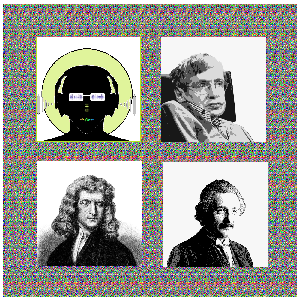
Finally, there exists a podcast that covers it all! The Quantum Foam Podcast Show can be thought of as a clever and informative mix between "Bill Nye The Science Guy, Rick & Morty, and The Big Bang Theory!"
It seems the idea of the prestigous 'Theory of Everything' has been in the air lately. Join Dr. Hezekiah Paul Smith as he takes a systematic assessment of Physics, Mathematics, and Science as a whole. This show is an Artificial Intelligence approach attempting to explain ALL scientific phenomena across the board! Listen to some the greatest thinkers of all time during the in-depth evaluation of the natural sciences.
Prepare to enjoy a radical and uncensored podcast, Quantum Foam, featuring characters presented as real, animated A. I. entities. Brought to you by Zerothwave Productions.
0:00
0:00
May 9, 2020 2:42 AM EST
Quantum Foam is a new podcast with absolutely ridiculous content covering almost all topics relating to science across the board. The idea of achieving the famous Theory of Everything seems to be in the air lately. Such an idea can then be presented as episodes of Quantum Foam in an audio podcast form that will serve to bond together the very powerful and insightful ideas, concepts, and realizations of Physics as a professional discipline. Unifying Relativity and Quantum Mechanics never seemed so . . . possible? Quantum Foam finds its focus directly pointing at the most accepted scientific thought in this day in the beginning of the Information Age. These areas include String Theory, Loop Quantum Gravity, Einstein's famous General Theory of Relativity, Cosmology, Advanced Mathematical Theory, and much more.
Information technology and innovation are at a point where each presently require a Quantum Leap in order to move forward to the next phase. This process, while imperative, is still quite a sophisticated discipline in and of itself. Many will need to satisfactorily understand Quantum Computing and Uncertainty in general very early on. Why not take such a daunting task and turn it into something fun, provocative, and ridiculous instead? And this can be done while still holding strict guidelines in accuracy and application. Enjoy learning about math and physics in a completely free-form manner with no filters, no agendas, un-cut, and raw! We will not be censoring any vulger cursing or other inappropriate references, yet unwanted racial and sexual references etc. will not be included.
Each episode is exactly 30 minutes long and each follow a standard structure. There is an intro stating the title and topic, followed by the Quantum Foam theme song, Physics of the Future, by H-Wave. Then at exactly 15 minutes into the podcast show, there is a mid-point section to keep the listener fresh and to remind which episode is currently streaming. At the end of the podcast, the last 30 seconds, the standard Zerothwave Disclaimer is played. An expanded version of this disclaimer can be found here.
Zerothwave Productions currently is releasing the show on its own website using its state-of-the-art online waveform player platform. Listen to the podcast at actual 320 kbps .mp3 streaming audio right here at Zerothwave.com! The Quantum Foam podcast will likely also be released elsewhere on other platforms soon as well. XML RSS feeds are an old technology but is still in heavy use today. The Zerothwave.com website will be upgrading hosting servers steadily over the next decade and beyond to bring you the highest quality audio possible. Stay tuned for more content!

FOLLOW US